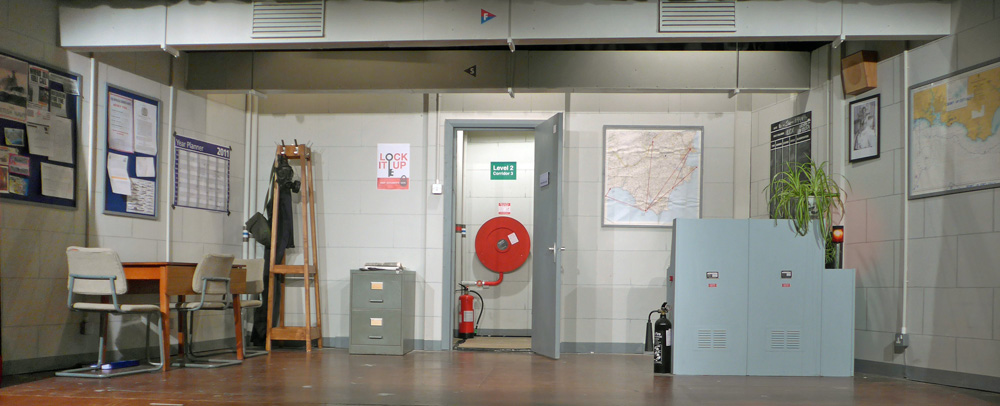
At a time when it might have seemed tempting to take refuge in a bunker far, far away from Brexit and Trump, SBADS needed to create one in South Brent Village Hall: although this one wouldn’t stand a blast from a cap gun, let alone an H-bomb. One of SBADS’s newest recruits, Tristram Grevatt, teamed up with one of the society’s stalwarts, John Gower, to create an alarmingly realistic world for Lynn Brittney’s Bunkered. In this article, Tristram tells us how it all came together.
Ignorance is bliss
Sometimes it pays to be ignorant: had I known that the SBADS stalwart who had just asked me “And how many nuclear bunkers have you been in?” was the former Assistant Chief of Defence Staff (Nuclear & Chemical, Biological), I might have been less confident in my answer of “four”. As it was, I found myself blissfully unaware that I was literally and figuratively outranked as I blundered my way through building a navy bunker with (retired Rear Admiral) John Gower.
Starting in the middle
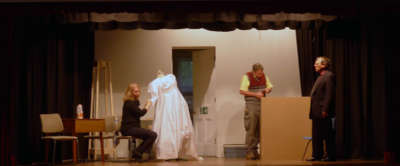
The stage at the start of rehearsals, with the original door (opening the wrong way) and unpainted props, and un-bunker-like window visible through the door.
Thanks to the need to get used to the space available, we started not with the walls but with the equipment. John and I wrangled a basic equipment console out of hardboard and two-by-two. He found a suitable table and filing cabinet at a local junk shop, and I hunted for chairs: an ex-Ministry Of Defence swivel chair that my father picked up in the ‘eighties from Bogey Knight’s was a good start, and my quest for better chairs than plastic stackers ended unexpectedly when I went to the village hall’s lighting room for flex… and found myself staring at three genuine ex-MOD Remploy chairs of exactly the right vintage.
South Brent Village Hall is a busy place, and the stage was needed on and off for other events in between our rehearsals. All we had to do now was wait for the stage to become free so we could build the final set.
It was a long wait.
Building the bunker
Less than two weeks before the dress rehearsal, two things happened: we were finally given the go-ahead to start building the set properly; and John was called away on business. In his absence, thanks to willing volunteers, the flats were mounted, a scenic door that opened the right way was dragged out of storage and fixed in position, and the real door taken away for a nice rest backstage.
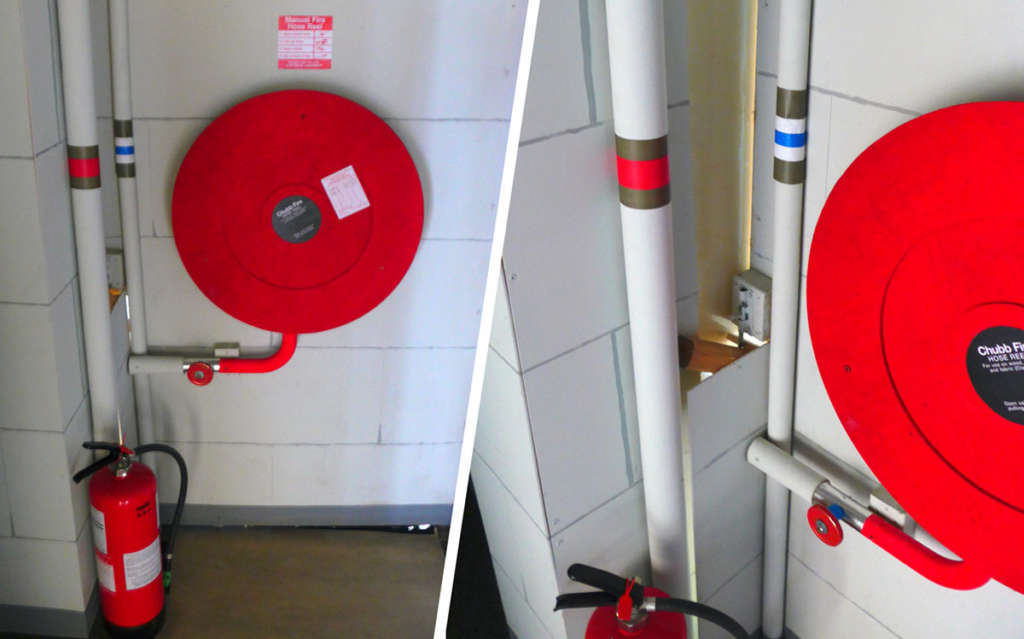
Mind the gap: hinged back ‘wall’ with fake hose reel, and pipes cunningly placed to stop the audience seeing the massive gap necessitated by the bannister.
Now left to my own devices, and still in blissful ignorance of the superior knowledge of my absent colleague, I started by building L-shaped ‘ventilation ducts’ from offcuts of thin plywood, scrap timber and thin battens. ‘Ventilator grilles’ were cut from a louvre cupboard door. The ducts were suspended on wooden struts between threaded rods: cheap, but both practical and authentic-looking.
Shadow lines were painted on the walls to simulated painted breeze blocks (it should have been painted brickwork: but breeze blocks are quicker to simulate…) and a false skirting board painted on. The distressingly pseudo-olde-worlde door was converted to a modern, flat type with wafer-thin mints waste packaging ply kindly donated by Wakeleys, with the luxury of a real architrave – to hide the gaps.
Behind the stage, the hall’s stairwell, windows and Edwardian dressing room doors needed to be disguised as a bunker corridor. I ignored the suggestion of ‘hanging up a black curtain’ (no, no, no) and made free-standing panels to disguise the dressing room doorways and a hinged panel to hide the stairs. ‘Pipes’ made mostly from cardboard tubes hid the gaps between these, and a fire hose reel made from plywood, a lavatory flush pipe and a jam jar lid completed the disguise. From the audience, you’d never know it wasn’t a real wall: except for the night when the cast were walking through the ‘wall’ as the curtains opened too early…
An obsession for detail
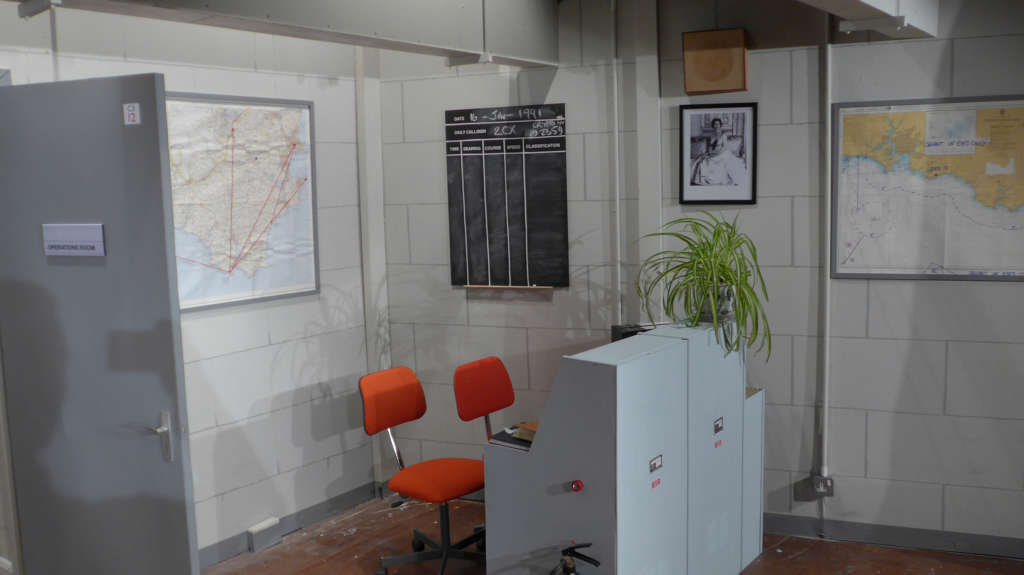
Charts, console and observations board. A genuine MOD chair sits alongside a fake created from a modern swivel chair. And lots of conduit.
Basic set constructed, it was time to add the detail. Fake ‘pipes’ and ‘electrical conduit’ were fitted to disguise the joins between the flats that made up the walls, along with suitable metal light switch and sockets; we lost count of the times that people actually tried to use them; including me, merrily flicking the switch and heading home one night before remembering that the real lights were still switched on. An old-style black CO2 fire extinguisher was fashioned from a decommissioned modern version: luckily, no-one needed to use it…
A suitably annotated Admiralty chart was provided by John, supplemented with a 1980s OS map marked up with nuclear bunkers of the time (or at least, as John commented, the ones that we know about…). An observations board was painted and chalked up: John added authentic data. An MOD ‘Lock it up’ poster was shamelessly recreated, and notice boards populated with archive posters, cuttings from Navy News (featuring not-yet-Rear-Admiral Gower) and entirely fake documents, from official correspondence to a maintenance log. The most difficult item to find was the most modern: no-one, it seems, keeps their 2011 wall planners!
Most of this was simply dressing. Three items featured in the script: two manuals and a telephone directory. The manuals were lovingly created from examples of 1980s MOD manuals shown in online auction listings. The directory needed to be thick enough to take the place of a 500-page manual propping up a table leg: not a problem a few years ago, but tricky now the Phone Book is a tiny shadow of its former self. Instead, I combined several old phone books and added a 1980s-style cover based on examples from roughly the right period found on eBay.
Finally, the computer/sonar/radar console received trim, vents, a CO2 port and suitable equipment labels, and a coat of naval-equipment blue-grey.
Lights, camo, action
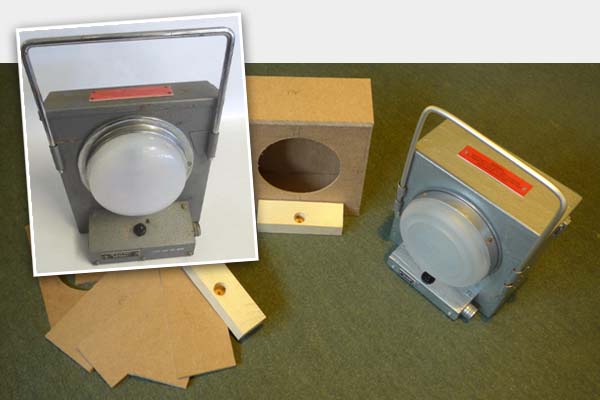
Photo of original metal naval lamp, probably American, found on eBay, and our version made out of timber.
‘Bunkered’ features several sections in which the power is switched off, and the stage apparently lit by battery lamps. We experimented with the latest rechargeable LED work lights, and found that they are now so bright that we could use them to light the stage on their own, casting a suitably dim, directional light and big shadows.
A complication arose in the stage directions, which required all the lamps to turn off and on simultaneously at the end and start of two acts, while various actors also switched them on and off by hand at intervals.
A photo of a (American?) navy battery lamp on eBay provided a suitably simple shape to work with. I built crude hardboard and MDF boxes with hinged lids to hold off-the-shelf work lamps, and wired chunky toggle switches in to the circuits to allow the cast to control them, with radio-operated switches to override them all remotely.
A coat of Hammerite, handles attached with bent picture hooks and ‘lenses’ made of plastic food containers completed the basic shape, with labels and sockets made of screw bottle necks to complete the look.
The finished article
Did it all come together all right? Luckily the director and John were happy! Apparently it was “utterly realistic”. For once, I will accept the compliment – and be grateful for my ignorance!