
Tucked away in our wardrobe was this history of SBADS, carefully typewritten by Maggie Taylor to mark our 70th birthday, and we’re delighted to publish the first part here.
Bright Beginnings
It was way back in the nineteen-twenties that the first drama group was formed in South Brent, and like many other local entertainment ventures to be launched in the years before World War Two, it came about through one of the locality’s all-time great entertainers.
He was the famous and celebrated Mr Arthur Manning, professional pianist and dance band leader, organist and choirmaster at St Petroc’s church, sometime Chairman of the Choral Society, accompanist to the Magpie Minstrels, and to the Joy Bells Concert Party, veteran of numerous amateur shows, and for nearly thirty years the best-loved figure on the South Brent showbiz scene.
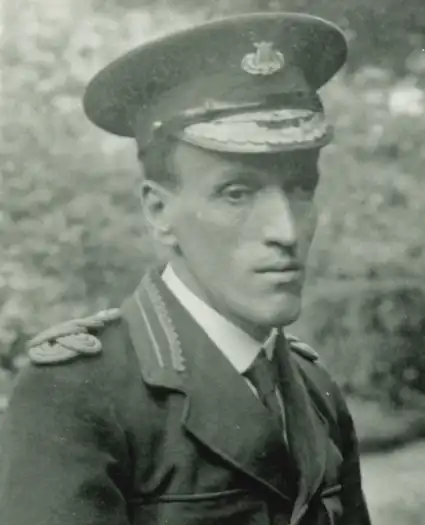
A keen fosterer too of other people’s talents, he was as well a zealous promoter of all sorts of entertainment in the village and was responsible for the introduction of several musical and theatrical groups, including the Brass Band, the Quadrille Band and the South Brent Pierrot Troupe. And to these in 1925 he added the amateur drama group, which he not only founded but also ran, and for which he acted as musical director, piano accompanist, singing coach, dancing teacher (on at least two occasions), script writer (on most occasions), and, in spite of being nearly blind, the resident producer too. Not surprisingly the village christened it Mr Manning’s group!
It was Arthur’s intention to feature his actors in one major show per year, each to be staged at Christmas time in aid of the Sunday School Outings fund, and the plan commenced with his own pantomime ‘The Beauty and the Beast‘. The first full-scale panto to be seen in the village, it opened in front of a huge audience, at what was then known as the Church Hall (now the Village Hall), on the evening of Saturday 26th December 1925. And sad to say, we know little about it. The brief report in the Totnes Times tells us that it featured a chorus of children and that the grown-ups included Vera Pine as Beauty, Theo Preston who was seen as the Beast, and Florence Tucker who played Fairy Silvergleam. It also tells us that just for once Mr Manning was not the accompanist (there was a reason for this, as we shall see in a minute) and that after each performance there were sundry amusements ending up with a dance. And that’s about all that it tells us.
However, a few more snippets of information have been provided by Mrs Elsie Preston who was one of the first people to join the group and who, on the occasion of the pantomime, had helped with the Interval refreshments. Although she could not remember much about the show she did have clear memories of certain things, like the singing and dancing of the chorus children which had been especially good.
‘But then, they had to be good,’ said Elsie, ‘because Mr Manning had very high standards and expected them to always do their best and not let down the production.’
And he was quite strict about it too. He had trained the youngsters himself, it seems, and every time they went on stage for one of their song and dance routines, Arthur had been there, standing in the wings and tapping his feet to keep them in rhythm – and it was woe betide them if they got it wrong!
‘And yet they all thought he was wonderful,’ said Elsie. ‘Well, we all did,’ she added.
Another clear memory that Elsie had was of the panto’s leading man. And she must have thought that he was pretty wonderful too because not long afterwards she married him. This of course was Theo Preston, whose performance in the comedy role of the Beast Elsie thought was one of the best that she’d ever seen him give, although, she said, he was extremely good in all his comedy parts.
She then went on to talk at length of Theo’s ability as a comedy performer, of his very high reputation as such, of his popularity all over the area, and of the many glowing Press reports which his performances had received.
Well, after that, you might be thinking that Elsie was just a teeny bit biassed where Theo’s talents were concerned. But in fact there are plenty of records to show that Mr Preston was indeed regarded as one of the area’s most outstanding and popular comic actors. (He was, incidentally, a quite outstanding female impersonator too – and we have the photos to prove it. And no, that’s not a pun!)
Another thing that Elsie recalled was that the after-show dance had been a great success. So great a success that although he had meant it to be part of this production only, Arthur decided to keep it in the programme and henceforth held a dance after every performance given by his drama group. And over the years it brought a happy end to such wintertime shows as ‘Pearl the Fishermaid’, ‘Bold Robin and the Babes’, ‘Santa Claus in Japan’, and ‘Snow White’, the first of many amateur productions to feature Mr Manning’s dance band. And of these shows too we know very little, save that they written by Arthur. However, we do have a bit more knowledge of another of his pantos ‘Aladdin and Out’, which, according to Mrs Preston, brought the group its first big hit.
It also brought the group its first big hiccup because it should have opened on the Boxing Day of 1927 but somewhere along the line a hitch occurred and the panto didn’t make the date.
What went wrong, nobody knows, but whatever it was it held up the panto until the second week of January 1928 when, despite the hitch, the cast turned in two excellent performances. And a couple of weeks later two more were given, one as a benefit for Mr Manning, to thank him for the work he’d put into the show, and the other for the patients at Bittaford Hospital who were unable to see it in the village.
In his element as Mrs Mustapha, laundry owner and Aladdin’s mum, Theo was on top form again, and nowhere more so, according to Elsie, than in the two ‘Laundry Lecture’ scenes, in which a very frustrated Mrs Mustapha keeps making attempts to teach her students all the tricks of the washing and ironing trade, while the students do everything in their power to turn the lesson into a complete fiasco and their teacher into a wreck.
Almost a match for Theo’s talents were those of his younger brother George, who played both the Prime Minister and the villain of the piece, the aptly-named Badmanazzar. A debut-maker in ‘Aladdin and Out’, George went on to be one of the company’s most talented all-round performers. And one of its greatest stalwarts too, as we shall see later on.
Other newcomers among the cast were Arthur’s niece Miss Violet Manning, another future mainstay of the drama group, and little Vera Preston, niece of Theo and George, who created one of the highlights of the show with her exhibition of a new dance craze that was sweeping the land at the time. Yes, that’s right, it was the Charleston.
And now for the question that every reader must be asking: why was the panto called ‘Aladdin and Out’? And once again no-body knows. However, one person did come up with a rather ingenious theory. It says that in this version of the pantomime story the magic lamp wasn’t really a lamp but a cunningly disguised wireless transmitter which the hero used to call up the Genie, and that ‘Aladdin and Out’ was his signing-off signal. Any other ideas?
As we’ve already seen Mr Manning demanded a lot from his young performers, but it was far from being a one-sided affair because he also gave a lot back. Indeed, he spent a great deal of his time in teaching and encouraging the budding entertainers – actors, singers and musicians alike – and made a special point of including children in all his drama group productions.
Usually confined to the ranks of the chorus or to small parts in the pantomimes, they came into their own in 1930 when Mr Manning decided to give them one third of a production to them-selves. For this some forty young drama groupees enacted a musical fantasy piece entitled ‘The Dolls’ Hospital’, and the audience was so enchanted by it that another performance was demanded.
Well, if Mr Manning knew a winner when he saw it, he must have seen a winner in this idea, for he repeated the formula in the following year, this time handing over to the youngsters one half of a variety entertainment. So they repeated the formula as well, with another singing and dancing piece called ‘Bo-Peep’s Picnic’, and this one too brought forth demands for an extra performance to be given.
The next logical step of course would have been an all-children presentation, and considering the success of the last two efforts it’s possible that Arthur would have taken that step if Fate had not intervened. But in 1934 he became unwell and, recognising the need to take a long rest from his numerous activities on stage and off, he regretfully decided that the time had come to give up the drama group.
It wasn’t the last that the village would see of its number one favourite entertainer – not by a very long way. And it wasn’t quite the last that the drama group members would see of their founding father. But it was the last that anyone would see of Mr Manning’s group, because quite suddenly after his retirement a management committee appeared on the scene, and just as suddenly the old company became South Brent Amateur Dramatic Society.
There were more changes in the pipeline too, but first there was to be another Christmas show. Or at least there was if a producer could be found, for it seems that none of the drama group members was willing to step into Mr Manning’s shoes and take on the burden of the job. All, however, was not lost, because it just so happened that a likely person had recently come to notice. Earlier in the year Mrs G Reynolds had staged a performance of her own pantomime ‘The Piper of Dreams’, and the quality of the production had left no doubt as to the lady’s capabilities. The pantomime had been in aid of the St Dunstan’s Institute for the Blind, so of course Arthur Manning had been involved in it too, and was possibly he who asked Mrs Reynolds to produce the winter show.
In any case, someone asked her to do so and Mrs Reynolds said that she would if Mr Manning would act as her adviser. Well, rest or no rest, Arthur agreed, threw in his dance band for good measure, and that December another huge audience crammed itself into the Church Hall to see another great pantomime.
Produced by Mrs Reynolds, written by Mrs Reynolds and with music and lyrics by Mrs Reynolds, ‘Magic Midnight’ was a mammoth hit with both the public and the press. According to one newspaper report it had everything required to make the perfect panto – tuneful songs, attractive dances, lots of magic, loads of comedy, some very eye-catching lighting effects, and scenery described as the most artistic ever staged at South Brent.
It also had twenty-two youngsters in it and they were much praised for their various portrayals of Gnomes, Fairies, Pages, Heralds, Young Courtiers, and Demon Sprites, with Joan Cole receiving a special mention for her dance in the Demon Cave scene.
There was some spritely acting from the principals too, especially from Molly Cole as the Palace Cook, and from the very gifted Doris Manning, another of Arthur’s nieces. Already, at the tender age of twenty, a seasoned singer with her uncle’s dance band, Doris now proved that she could act as well with a skilful performance as the Savage Queen who is hell-bent on marrying one of the Three Princes, despite the fact that they are all scared silly at the thought of marrying her.
But the star of the show was undoubtedly her brother. Known to his fans far and wide as Razzle Dazzle of South Brent, Charlie Manning took on the leading comedy role of the Palace Chef and razzle-dazzled everyone with it, not least the man from the Western Guardian who declared that Charlie was a born comedian, a good singer, and altogether the most outstanding person in the cast. (He was quite outstanding on the cricket field too – but that’s another story.)
Once again an extra performance was given as a benefit for Arthur Manning, this time in recognition of his many years of unstinting work for the village. After the show, the Reverend Gallagher told the two-hundred-odd people present just why they had all turned up. It was, he said, to show how much they all appreciated Mr Manning, first for his willing charity work, second for his great skill and learning in music, third for continuing to use that skill to earn his living and entertain the public, though under the handicap of having almost no sight, and fourth for his great personal character which had endeared him to all who knew him.
Arthur’s reply was a lot briefer and a lot less colourful too.
He merely thanked everyone for making the evening such a success, then heaped his own praises on Mrs Reynolds for her ‘truly great production’. The Vicar agreed with this description and added that Mrs Reynolds was a marvellous producer and that they all ought to be very proud to have her in the village.
Alas, they didn’t have her for long, because shortly after ‘Magic Midnight’, Mrs Reynolds packed her bag and left South Brent for good.
Dramatic Pause And Final Flourish
June 1935 witnessed the first Annual General Meeting of South Brent Amateur Dramatic Society, Capt. Carnochan being in the Chair and the others sitting around the top table being Alice Vickery (Secretary), Mr H Symons (Treasurer), and Edith Hodson, Stanley Jefford, the Rev. Marshall and Charlie Manning (general committee members).
The first thing we learn from the report of the meeting is that the SBADS committee had put into practice its new policy of presenting plays, one of which had been very successfully staged in the previous Spring. This had been Eden Phillpotts’ ‘The Farmer’s Wife’, a comedy in the Devonshire dialect, and in view of the fact that it had gone down well, and had made a fair-sized profit to boot, the meeting felt that something similar should be chosen for the coming season.
Which indeed it was, for the play selected was that old favourite ‘Devonshire Cream’. And this too encountered a bit of a hiccup when its producer the Rev. Marshall was taken ill and couldn’t continue with rehearsals.
Worse still, there was no one available to take over the reins from the ailing Reverend and as the weeks slid by it began to seem that the production would have to be cancelled. It wasn’t though, because Edith Hodson, gamely shelving all her other work, stepped into the breach with just a few weeks to go and pulled the play together so quickly that it was able to open on its allotted date of May the 5th 1936. And it received some very good reports from the Press, Mrs Hodson herself getting most of the praise for the way in which she had directed it, and Mr Symons, who played the part of the stubborn-headed farmer Elias Widecombe, being commended for his good acting, and especially for what the reporter called ‘his delightful intonation and gestures’.
There were appreciative comments from the village too and due to the large attendances at every performance, another profit was made. So with two successful productions in the can, the new-look drama group must have felt that putting on plays was paying off and that a rosy future, drama-wise, undoubtedly lay ahead. But it was not to be.
At the AGM in the following September Capt. Carnochan told the meeting that although the past season had been a success he was sorry to note that the bulk of the work had fallen upon the shoulders of the few, which wasn’t good enough. He therefore hoped that in the coming year all members would do their utmost to help, and especially to give their support to Mrs Hodson in her efforts to produce ‘It Pays to Advertise’ which was due to be staged next February.
The play, however, was not put on. Nor was any other play ever presented by the Captain’s band of thespians. The drama experiment had failed, it seems, though whether through lack of the members’ support or for some other reason isn’t known.
The village, though, was not disappointed, for a production did go on in February, thanks to Arthur Manning. Much recovered after his long rest, he gathered together the drama group members, Naomi Cranch and her Brownie Troupe, and the youngsters from his newly-formed Juvenile Band, and put them all into one of his ever-popular variety shows. And the packed audience gave them all a roof-raising reception, the young musicians of the Juvenile Band collecting the largest amount of applause for their rousing Finale music.
And on that bright note the drama group curled itself up and went into hibernation. And not long afterwards so did almost the whole of village entertainment. Once again, we don’t know why, though it might have had something to do with the fact that around that time everyone’s mind was daily being more firmly rivetted on a much more important matter. For the storm that had been raging across the Channel was now showing every sign of heading for England.
And on September 3rd 1939, it arrived.
Interval – With Action
Everyone knew it was coming of course and South Brent people, like Britons everywhere, had begun to prepare themselves for war well in advance of Mr Chamberlain’s wireless message on that fateful day. And drama group members, past and future, were in on the action from the start.
As early as the Spring of 1938 the distinguished artist Christine Raikes, scenery painter for the SBADS plays, had already set up a Red Cross unit and was organising lectures on how to nurse the wounded and what to do with a gas attack victim. And shortly afterwards, Capt. Carnochan, now area officer of the Special Constabulary, was gathering together a squad of wartime coppers, helped by Special Police Sergeants H Symons and Ernie Catt Snr. Then in March 1940 a branch of the Women’s Voluntary Service was formed, and Alice Vickery and Winifred Windatt were among the first to become ‘green angels’, as the ladies were affectionately known.
About the same time, Edward Pinhey, Maurice Elliot and Evie Hard were swelling the ranks of the Civil Defence Corps, and all through the long hot summer that followed, Sergeant George Preston and Sergeant George Salter could be seen on many a balmy evening marching such men as Alan Perkins, Owen Winzer and Edward Rowe down Plymouth Road and into the drill hall for indoor Home Guard exercises.
Edward Rowe was also in charge of the aircraft-parts factory at Millswood Mill where, among the girls doing their best to keep the boys in blue in the air, were Gwennie May, Daisy Rowe, Pat Stancombe and Ruth Hard.
The wonderful Women’s Institute was helping the cause in a different way, Violet Manning, Gladys Salter and Anita Perkins being only three who were running whist drives and jumble sales in aid of wartime needs. They were also busy inventing recipes, using only unrationed food, organising collections of waste-paper, and forming sewing circles at which everyone could learn the new art of Make-Do-And-Mend.
Along with their sisters in the WVS, they were hard at it too knitting miles of wool into socks, scarves, helmets and gloves to keep the Army and the Navy warm, and when they weren’t doing that, they were weaving camouflage nets for the merchant seamen. And in August 1940, when Lady Astor opened a canteen in St Michael’s House for servicemen in the area, most of the ladies found time as well to help Edith Hodson and Carmen Manning to serve food and drink to the men.
Nor was that the end of the women’s work, for they were also playing host to one or more of the two-hundred-odd evacuees who fled to Brent hot-foot from London in 1939 and 1940. Evie Hard took two of the children (who continued to visit her long after the war), and Anita Perkins lodged five of their teachers whose pupils invaded the house as well and nearly drove Anita up the wall with their non-stop recorder playing. As for Brown Owl Naomi Cranch, well, she was allotted a houseful of little girls, and it will come as no surprise that she turned the lot of them into a Brownie Pack.
The Plymouth Blitz brought more evacuees and one at least was no stranger to the village, for when Rosalie Smeeth lost her home in the city, she and her little daughter Inez, who was also destined to tread a few boards, came to settle down in the cottage in Church Street which had been Rosalie’s childhood home.
In all, 671 evacuees descended on Brent during the course of World War Two, and billeting officer Jack Preston had to find them somewhere to live. As one senior Brentonian put it: ‘Not a house in the village was safe’ And neither, come to that, was the Church Hall which for nearly six years did duty as a temporary school for the displaced children.
The war, of course, was not only responsible for bringing people into Brent; it was also responsible for sending people away – en route for the armed services. Arthur’s son Roy joined the Fleet Air Arm and Margaret Winzer enlisted in the WRNS, while Francis Moores took to the skies and did such great deeds in his aeroplane that the RAF awarded him the Distinguished Flying Cross. All three came safely home, though Pilot Officer Francis Moores did bring a few injuries with him. But one person who didn’t return was our old friend Theo Preston, who joined the Royal Navy at the outbreak of war and lost his life while serving at sea in May 1942.
Theo would have been glad to know that his fellow entertainers back in Brent had by this time got their act together and were going all out to do their bit in their own special way. Led by Arthur Manning as usual, they were staging shows in aid of the Red Cross, the Merchant Navy, the Air Training Corps, the Women’s Land Army, the Local Forces Fund, Battleship Week, Wings for Victory Week, and Mrs Churchill’s Aid to Russia Fund, to mention only a few.
And it wasn’t only the entertainers who were treading the boards for the war effort; other Brentonians were doing it too, many of whom had not so much as set foot on a stage before. Nor was the activity confined to village people. The men of the Liverpool Scottish Regiment, based at the camp by Sanderspool Cross, were chipping in too with their bagpipe music – and when they marched out, the Yanks marched in, and soon the Church Hall was positively bouncing with the altogether jazzier beat of their GI band concerts – which increased the piles of money no end!
Meanwhile, in the bosom of the WI, a dark-haired, dark-eyed, lively lady with a lovely singing voice and a lot of other talents, was keeping the flag of drama flying by producing the ladies’ plays. And with one of these plays in 1943 she opened a long-closed door. She was Georgina Lucy Hawke, known to everyone as Lulu, and the play in question was ‘Ladies in Waiting’, which was first staged in the Spring of that year in aid of the RAF.
Now, the WI ladies had long been known for the high standard of their all-women plays, but this one must have been something special because Mrs Hawke was inundated with requests for a repeat performance. And it was mainly due to this great reception that memories of the old drama group were revived and that the thought took wing in many people’s minds that it ought to be reinstated.
So being the natural-born leader that she was, Lulu at once set to work on the scheme – and it blasted off with all the force of a shell from an ack-ack gun. People flocked in with offers of help, actors, technicians and back-stage workers materialised as if by magic, and even the Totnes Times gave backing by publicising the project.
In the following October Lulu repeated ‘Ladies in Waiting’ as an opening production and after six whole years of being redundant the drama group was back in business. It was back in business with another name too, though it isn’t easy to say what it was, since the records refer to it by several names, including the Brent Repertory Group, Mrs Hawke’s Repertory Company and the South Brent Repertory Players. You’ll just have to take your pick!
Lulu’s Lot
The dynamic Lulu lost no time in getting the next show on the road and three months later the village was treated to Eden Phillpotts’s ‘Yellow Sands’, another play in the Devonshire dialect. A special performance was later given to the American forces in the area and we are told that they very much enjoyed the play, though how they managed to understand a word defies all explanation.
The dialect presented no problem at all to the members of the mainly Devon-born cast, but when it came to the matter of speaking at all, one did give cause for concern. He was Lulu’s pet parrot, who played the part of another parrot, and it seems that someone had taught him to swear, so that all the time he was on the stage, the whole production team was rigid with fear lest the bird decided to give a demonstration of all the naughty words he knew. Fortunately, though, he didn’t.
The play featured many of the group’s new members, among them village tailor George Salter (still a sergeant in the Home Guard) who had the leading role of the boozy and belligerent old reprobate Uncle Dick. Also making his debut – as actor, stage manager and set-builder too – was the multi-talented Charles Tothill, who made an excellent start with his portrayal of the rampant socialist Joe Varwell.
But his best piece of work was his amazing set. First depicting a part of the beach, complete with crab-pots, rustic seat, nets, cottage and full-sized fishing boat, it then became an old-fashioned parlour stuffed to the eaves with bric-a-brac and furniture, including the inevitable piano. The job of turning the one into the other was of truly Herculean proportions. It involved not only removing the beach, taking down the flats and turning them round, then lugging on the parlour furniture, but also setting nearly ninety props and articles of stage decoration.
‘Everyone agreed it was a Masterpiece’, enthused the man from the Totnes Times, though doubtless the people who had to change it used a different word to describe it.
There was no such trouble over scene-changing with Lulu’s next production ‘The Ghost Train’, whose one simple set was the shabby waiting room of a country railway station. There was, however, a whole lot of trouble over one of the stage effects. At one point in the play the off-stage ghost train is supposed to rush through the station at speed, belching a substantial amount of steam all over the waiting room set. The trouble was that a way of producing sufficient steam could not be found, and as opening night drew ever closer, nerves grew ever more stretched.
Then George Salter had a sudden brainwave, and come the next rehearsal, he walked into the hall with his goose tucked underneath his arm.
No one believed that the plan would work, but Mr Salter was sure that it would, so the goose was put to the test. George’s wife Gladys remembered the incident ‘as if it was only last week’. The goose, she explained, was heated on an oil-stove placed behind a flat near the up-stage door, and a bucket of old water was put beside it, along with a member of the stage crew. The ghost train sound effect was then started up and just when the noise was at its loudest, showing that the train had reached the station, the hot goose was drenched with the freezing cold water – and in through the door and all over the set billowed the steam in abundance.
No, don’t worry, it didn’t involve being cruel to an animal.
George, remember, had a tailoring business, and his ‘goose’ was the special iron he used to press his newly-made garments.
There had never been a more hectic year for drama group members than 1945. Come to that, it was rather hectic for everyone else as well.
For the Players it began in the early Spring when two productions went into rehearsal, the first being a variety entertainment to be presented at Diptford. This went on at the end of April and barely had it finished when the bells were ringing to announce the arrival of VE Day, and the whole village was suddenly flung into a frantic whirl of activity. Flags and bunting were hastily hoisted, festive events were rapidly arranged, mainly by the drama group’s Trevor Jones, red, white and blue clothing was quickly made, and every last table and chair in Brent was hauled out and placed along the length of Church Street, ready for the children’s tea-party.
Food was still on ration of course, but nevertheless there was a right royal spread – or so it must have seemed to the hordes of youngsters who sat at the tables stuffing themselves with fishpaste sandwiches, red and yellow jellies, powdered lemonade made up into a drink, and South Brent’s own traditional tuff cakes (soft bread rolls spread with jam and cream for those who don’t already know). Arthur Manning brought out his harmonium and played popular songs for the little diners, who somehow managed to sing along without ceasing to eat.
After the meal, the tables were removed to make way for a Floral Dance all round the village, which was followed by a trek to the top of Brent Hill to witness the lighting of a mammoth bonfire and to generally lark around until it was time to watch the fireworks display.
Back in Wellington Square, meantime, Arthur Manning was on again, playing the music for the dancing and singing that went on until nearly dawn.
Next day there was a party for the senior villagers, arranged by Carmen Manning, and for the children there were sports and games in the field opposite the school. And that evening saw the Church Hall festooned in decorations of red, white and blue, for the occasion of the Grand Victory Ball, music by Arthur’s dance band. Two days later it was Carnival time, with Alice Vickery crowned the Victory Queen and Nana O’Connell winning a prize in the fancy dress parade.
Sunday dawned with another parade, in which every uniformed body in the place, right down to the teeniest Brownie, marched behind the band to St Petroc’s church for a special thanksgiving service. But they hadn’t finished yet because as well all that there were two concerts, another dance and another fancy dress parade. As a second senior villager said: ‘We’d never had so much to do in Brent. There was something going on morning, noon and night and some us, the young ones, didn’t get to bed till it was time to get up again.’
For Anita and Alan Perkins, though, there was one tiny flaw amid all this joy. They’d been given a large bottle of good Champagne, to be consumed on VE night, and it was duly uncorked and one drink each poured out for the Perkins and their lodger. At which moment a tumult outside announced the arrival of a troupe of revellers, who were doing the Conga up Plymouth Road and singing at the tops of their voices. So Anita and Alan decided to go and join in the fun for a while. But they got so caught up in it all that they forgot to come back in. Eventually, though, the troupe danced off and the two Perkins returned indoors, all ready for an evening of bubbly drinking – only to find the Champagne bottle with not a drop left in it, and their lodger lying flat on her back in a deep and happy sleep!
The week-long celebrations were rounded off by the Players’ very successful production of the anonymous letters mystery ‘Poison Pen’, though it was not for its success that Marjorie Skinner would always remember it. Marjorie, who played the part of Rose Rainrider, got married half-way through the production to Lieut. Jack Vaira of the United States Army – and then postponed the honeymoon they’d planned so that the play could finish its run. Later in the year she went off to the States, there to raise a family, but she always kept a special place in her heart for the village drama group. And in the 1950s when she returned for a long holiday, she rejoined SBADS, served on the committee and took part in three more plays.
With two productions in around four weeks the Players must have thought that they were due for a rest. There wasn’t the slightest chance. Even as ‘Poison Pen’ was packing ‘em in, Lulu and Betty Sheppard were devising a show to mark the end of the war in Europe – and what a show it turned out to be.
A joint effort of the Players and the village, the Victory Variety Concert as it came to be known went on stage in the following July and was one almighty smash hit. Three One-Act plays started it off and then came the main event, a lavish and colourful extravaganza which had the title of ‘Dancing Through the Ages’, though in fact it contained a great deal of singing, sketches and comedy too.
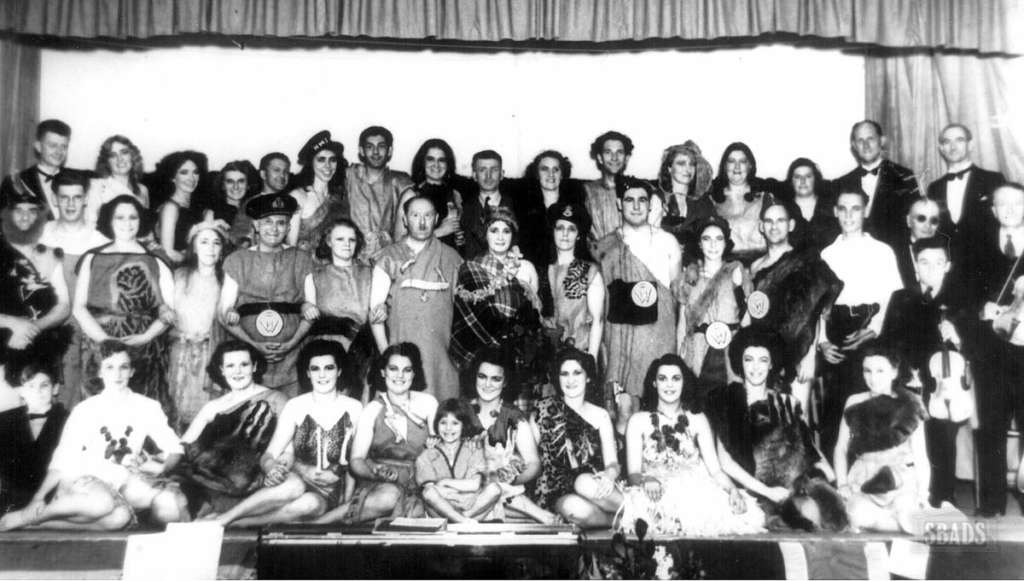
A veritable cornucopia of entertainment, it opened with the hit songs of the recent war, then rolled back through history with exhibition dances of the nineteen-twenties, Edwardian drawing-room ballads, items from the Victorian music hall, nautical scenes from the days of Lord Nelson, a selection of dances from the early days of ballet, songs and stories in a medieval turret, and a host of other historical scenarios, ending up with a large set-piece in which Bronze Age Brentonians welcomed home their warriors returning from battle.
The whole show was beautifully costumed too, a wondrous achievement in those days of clothing coupons and dire shortage of materials. And for the first time we know what the costumes were like, for Mrs Hawke had the presence of mind to employ a photographer to snap the show and many of his photos have survived the years and now reside in the SBADS archives.
Without doubt the most successful and popular production that had ever been staged in the village, it played for three nights to a Church Hall packed to overflowing, and still Alice Vickery, in charge of the seating, was being pestered for tickets. The company, therefore, gave another performance, which also played to a packed Church Hall, and when the final totting-up came to be done, it was found that almost 1,500 people had paid to see the show – a record that remains unbroken.
August brought an end to the war with Japan and another week of jollifications for Brent, with Wellington Square floodlit for the occasion by John Hawke, Lulu’s son and the Players’ electrics man. There was no big production this time though.
Instead the Players took part in a concert arranged by the local Royal Marines, and a month later, by special request, they resurrected ‘Poison Pen’ and took it to Totnes to help raise money for the town’s Welcome Home fund.
And then the company did have a rest, and a very long rest it proved to be, for not until October 1946 did they put on another play. The American thriller ‘The Thirteenth Chair’ had a reputation for being unlucky, and it was certainly unlucky for Lulu’s lot, for with it Mrs Hawke took her final bow, compelled, like Arthur Manning before her, to give up the group through illness.
In an attempt to keep things going lest the loss should cause the company to crumble, Edward Rowe at once took charge and produced a pantomime, ‘Dick Whittington’, which was staged in the following December. But although it proved to be another big hit, it seems that the momentum couldn’t be sustained, for no production followed in its wake, and for the second time since it came into existence the drama group went into limbo.
This time, though, it didn’t stay there for long. In August 1948, following a barrage of requests from the village, George Preston, George Salter, William Windatt and Walter Vickery set up a committee with Walter as Chairman and reformed the group under its old name of South Brent Amateur Society. A year later Walter Vickery retired and George Preston took over as Chairman of SBADS. He was to hold the post for nearly twelve years and for all but the last eighteen months of that time, his inspiring and dedicated leadership was to create a climate in which the drama group would flourish as it never had before.
The Golden Years
The news of the revival resulted immediately in a great tidal wave of new members, as well as the return of most of the old ones, and to make the most of them the committee decreed that a pantomime with a large cast should be chosen as the kick-off production. So Betty Sheppard and Margaret Jones got down to writing ‘Sleeping Beauty’ and managed to cram in forty-five parts, twenty of them for principals.
Betty Sheppard was also the producer and she decided to break with tradition this time and cast a young man as the Prince.
And David Grigor was quite happy with the part – until he found out that he’d have to go on stage wearing a pair of tights. He wouldn’t do it. He would look like a girl and all his mates would laugh at him, wouldn’t they? But Mrs Sheppard would not be swayed, and after several weeks of arguing, reasoning, nagging, cajoling and even begging, young Mr Grigor’s defences crumbled and he consented to wear the dratted things. And very handsome he looked in them too.
Drawn from the realms of Fairy Tale and Nursery Rhyme, the story was peopled by a host of colourful characters, including Mother Hubbard and Mrs Jack Spratt, played respectively by a dainty George Salter in black bombazine and corn-coloured curls, and village butcher Owen Winzer, a demure but decidedly hefty charmer in white frills and flounces. For Mr Winzer once was enough in what he called ‘that awful bra’. ‘I told them,’ he said, ‘never again – not for all the money in the world.’
Mr Salter, however, had no such qualms and happily went on to play the Dame in four more pantomimes, including Charles Tothill’s version of ‘Aladdin’, staged in December 1950, which broke all records by giving more performances than any previous drama group production (six in the course of five days).
The pantomime was notable too for introducing a very talented and experienced choreographer to SBADS. Sheila Phillips, who had done her training in two of the county’s top schools, came to Brent in 1947 and set up her own School of Dance in the village in 1948. From then until the end of the nineteen-fifties almost all of her young pupils danced their way into SBADS productions under her expert tuition. Sheila, on the other hand, danced her way into the heart of the above-mentioned butcher and before she had choreographed her second show she had become Mrs Owen Winzer.
This, however, was not to be yet, because the first half of the nineteen-fifties was devoted almost entirely to plays. And one of them witnessed the stage debut of a future professional actor. In April 1951 twelve-year-old Michael Edwards was picked to play Bill in ‘Dear Octopus’ and a year later was chosen for the part of Dunsford Biggs in ‘Golden Harvest’. He then left the village, eventually grew up, did his National Service with the RAF, and afterwards signed on at the Central School of Speech and Drama where he changed his name to Michael Guant.
Since then he has appeared in over two-hundred stage productions and a fair number of television plays, including ‘Blake’s Seven’ and ‘Lilli’ in which he played Lord Randolph Churchill.
Of the nine plays staged in the early nineteen-fifties, eight were in the very capable hands of schoolteacher Joy Carnochan. A firm and no-nonsense kind of lady, who expected prompt attendance at every rehearsal, she was also a very sensitive director with the ability to coax from her performers every last bit of talent that they had. This and her meticulous attention to detail resulted in some highly-polished productions, the pick of the bunch, according to the Press, being the Christmas favourite ‘But Once a Year’ and Emlyn William’s thriller-chiller ‘Night Must Fall’, which saw George Preston surpassing himself as the psychopathic killer Danny.
Miss Carnochan also had the honour of presiding over the first SBADS play to be put in for a drama prize when, in 1952, she entered ‘Missing’ in the Plymouth One Act Play Competition. It got precisely nowhere, but, ever undaunted, the committee sent it off to the Paignton Drama Festival where a slightly more appreciative judge placed it fourth in its class. Well, it was a fair enough start.
June the 2nd 1953 brought another excuse for village merry-making. It was, of course, the Coronation Day of the young Queen Elizabeth the Second. It was also the birthday of the young Inez Smeeth, but so busy was everyone decorating all the houses, taking part in the festive events, and listening to the wireless commentator describing the glittering scene in London, that the girl and her birthday were completely forgotten. Ah, poor Inez.
The Society’s contribution to the celebrations took the form of three One Act plays: ‘The Saint’, ‘The Bonny Earl of Moray’, and, inevitably, ‘Queen’s Progress’ in which Evie Hard gave a shining performance as the new monarch’s illustrious great great grandmother Queen Victoria. The historical costumes for this production were designed and made by Joan Deedes, and they so impressed her fellow members that at the next AGM they elected Joan as their first official wardrobe mistress.
At the same AGM Chairman George Preston loaded Mrs Deedes with another big job when he proposed that a panto be staged in January and ‘volunteered’ Joan to produce it. She must have wished she’d never turned up! But she set about the task with her usual gusto, first devising the story line, then getting Hugh Butler to write the script and his wife Ann to compose the music.
The three came up with ‘Cinderella’, one of the Society’s most popular productions, which opened in January 1954 to an audience of over 300. Pam Andrews as Cinderella and Christine Preston as Prince Charming headed the fifty-one-strong cast which also included George Preston (Christine’s dad) in the role of the Baron, Anita Perkins as his Baroness, and Evie Hard and Rosalie Smeeth as Cinders’s horrible sisters.
Joan Deedes again provided a quite mouthwatering collection of costumes; but top marks for spectacle on this occasion went to one of the props. It was a gorgeous golden coach hung with glittering coloured lights, and it drew gasps of wonderment at every performances as it glided across the stage on free-running wheels, carrying Cinders to the ball. The work of the highly-skilled Alan Perkins, it was the talk of the village for weeks on end and even spread its fame to far Totnes whose own drama group in the following year begged for permission to use it.
Alan and the Society both agreed – and lived to bitterly regret the decision, for while it was there an accident occurred and the coach was never seen again.
There was a time in the panto when George Preston must have wondered if Anita Perkins would ever be seen again, at least in this production. On stage as the Baron, George called out to his panto better half to come on and join him. In fact, he called her several times, but the Baroness didn’t appear. In the end George Gave up. ‘All right then, if you won’t come here, you can stay out there,’ he quipped. He then proceeded to ad lib until Anita, scoffing a sandwich in the basement, realised with a jolt that she’d missed her cue and, frantically trying to swallow her snack, streaked full-pelt up the back stairs and out onto the stage. ‘And about time too,’ said George.
Following the success of ‘Cinderella’, George and his committee decided that SBADS should put on a pantomime every year and that Joan Deedes should produce them. So Mrs Deedes, having agreed, got started straight away on devising ‘Dick Whittington’ – and gave herself the job of directing the largest number of people in a panto to date: fifty-eight in all. The Press reporter who attended the show seems to have been rather intrigued by the number, for he went so far as to work out that fifty-eight people in the panto meant that one in every thirty villagers was involved in it in some way or other. But he eventually dragged himself away from this thought and turned his mind to the merits of the actors, the best in his opinion being Harry Westcott (another well-known village comic) who ·had shown more than ordinary·understanding of comedy in his role of Idle Jack.
However, he said, the most impressive feature of the show was its scenery, and especially its ‘beautifully executed backcloths’, designed and painted by Hugh Butler.
A clever and inventive man all round, Mr Butler was also responsible for another very pleasing pantomime feature, though he didn’t invent this particular one since it had been invented long ago. In 1956, Mrs Deedes having found herself much bogged down by extra work, Hugh took over as panto producer with his own version of ‘The Goose Girl’ for which production he had the idea of reviving the old pantomime tradition of putting on a Harlequinade at the end of the main show. It was very enthusiastically received [if not by the local press – have a look at the cutting!]. Choreographed by Sheila Winzer, who also danced the part of Harlequin, it had Pam Andrews as Columbine, and George Preston as Pantaloon, while Joan Deedes scraped enough time together to take on the part of the Clown.
It had, of course, involved a lot of hard work, but as Mr Preston said, it was well worth the effort because the audience had so enjoyed it. Yes indeed, and what a pity it is that the village public was never given the chance to enjoy such a tradition again.
As well as the annual pantomimes, the committee decreed that the yearly programme should include a Spring production chosen to develop the skills of the younger members, and an Autumn play which would aim for as high a standard of excellence as possible. Well, the Autumn plays, all produced by ex-drama teacher Harry Grinder, certainly achieved a very high standard; but so too did the Spring productions, many of whose youngsters did so well that Mr Grinder purloined them for parts in his Autum plays.
One such youngster was Jenny Truran, who was first snapped up by Mr Grinder in November 1955 to play Maisie in ‘Haul for the Shore’. And he was so impressed by the sixteen-year-old that a year later, when he produced ‘Bonaventure’, he gave her the very demanding role Sarah Carn, the young artist wrongly accused of murder, and to quote the Totnes Times, ‘She played the part almost to perfection.’
Thereafter, Jenny turned in a number of very creditable performances, and did much sterling work off-stage too, serving on the committee for eighteen years, many of them as Secretary. One of the loyalest and keenest SBADSites, she continued to give her all to the group until the onset of illness in the late 1970s, when she became the first person to be made a Life Member for her long years of service to the Society.
Another performer of no mean talent, who wasn’t a youngster but not an oldster either, made his debut at the end of the decade in Mr Grinder’s production of ‘Golden Rain’ – and a star was born, as they say. Ex-RAF type Graham Jordan, who had recently married Inez Smeeth, leapt into the limelight in the role of a reporter and so captivated one genuine reporter that he was moved to tell his readers that Mr Jordan’s performance was the best he’d ever seen in Devon. Unfortunately for SBADS Graham was able to sparkle with the group for only six years though he did return at a later date to make a guest appearance as Master of Ceremonies in ‘The Good Olde Days’.
Fortunately for the village though, he carried on using his wit, talent, personality and great stage presence in various other local entertainments and is perhaps best known for his legendary sketch ‘Still Sat Outside the Post Office’. And long may he continue to sit there.
In 1957 the Prime Minister Harold MacMillan told the British people that they’d ‘never had it so good’. And if he’d said the same thing to the drama group people he wouldn’t have been far wrong. On a practical level the company certainly witnessed a hitherto unreached peak of performance in the nineteen-fifties. It had a larger and more vigorous membership than ever before, it staged more productions than ever before (an average of just under three per year), it enjoyed more social and other off-stage events than ever before, it possessed more equipment than ever before, and it had a great deal more cash in its coffers than at any time in the past.
It was also managed more efficiently than in any of its previous incarnations, and many people who had been members in the fifties have said as well that SBADS in those days was a very friendly and welcoming group in which almost everyone got on well with almost everyone else.
Anita Perkins went even further. ‘They were marvellous times,’ she said. ‘The Society had such a good atmosphere then – it was like one big happy family really. And we always seemed to have such a lot of fun. Oh yes, they were very happy years – I often think of them even today. And it was all due to George, you know.’ (She meant Mr Preston, of course.)
Sounds like heaven on earth, doesn’t it? However, life never being quite perfect, the fifties had their problems too. And there were plenty of them with ‘Little Miss Muffet’ which had the misfortune of falling victim to a very nasty ‘flu epidemic. It began soon after rehearsals started in the late Autumn of 1956 and didn’t end until the panto was over in January 1957.
Almost every member of the cast was laid low by the bug at one time or another and so many people kept dropping out that even some of the understudies had to have understudies. The chorus children were the worst hit and replacements for them were still being sought two days before the curtain went up. The principals didn’t do much better, though. Eight-year-old Sarah Deedes recovered only just in time to go on stage in the title role, and plucky principal boy Ruth Dodd crawled from her sick bed to don the fishnet tights at almost the very last moment. The wonder was that the panto managed to get on stage at all. But it did, and except for a few nerves at the beginning, the whole thing went quite smoothly.
‘Flu epidemics were rare, of course, unlike the hated mobile cinema which, throughout the whole of the nineteen-fifties, turned the Church Hall into a picture palace every Friday evening. When a production was running it meant that the set had to be dismantled on the Thursday night, stuffed into the dressing rooms and under the stage, then yanked back out on the Saturday and re-assembled for the next performance. It was far worse when a panto was in progress because then the re-assembling had to be done in time for the Saturday matinee, thus demanding a very early start. Panto producer Joan Deedes called the whole carry on ‘a positive migraine’, and there was no relief from it until the end of the decade when the advent of the television set made the mobile cinema obsolete. (It made a lot more trouble for the Society too – but we’ll hear about that later on.)
Not so much a migraine as a bit of a headache was another problem involving Mrs Deedes. It came to be known as The Case of the Curtains and the story goes something like this:
In October 1956 Joan wrote off to a certain firm to get a quote for two curtains that she needed for a play. The quote was received in the following December and the curtains were duly ordered. Six weeks later the curtains arrived. Both were half as wide as Joan had requested and one of them was twice as long. Joan wrote asking for the curtains she’d ordered. The firm wrote saying that she’d had them.’ Haven’t’, said Joan in her next letter. ‘Have’, said the firm in reply. And so it went on for yet more weeks until finally the firm admitted that it had indeed sent the wrong curtains and that SBADS would therefore be charged only for the yardage of material. At which point Mrs Deedes gave up – still without proper curtains. Needless to say that particular firm was never used again.
It wasn’t only the members of SBADS, but most other people in the village too, who fervently wished that something else need never be used again. This was the Church Hall’s so-called heating system which consisted of two large coal-burning stoves, placed one at each side of the main hall, presumably so that heat would circulate evenly. It didn’t, as it happened, but what did was the enormous amount of smut-laden smoke which the monsters coughed out every time they were lit and at frequent intervals thereafter. So bad was the problem that door and windows had to keep being flung wide open to clear the fuggy air. And this, of course, threw up another problem, for as the smoke was sucked out, the cold was sucked in, so that people either had to sit there shivering or sit there coughing and spluttering like the stoves. Mostly they chose to shiver.
There was a problem as well for the wardrobe mistress, though it wasn’t the smoke but the coal it came from that caused her particular worry. In those days there was no side hall, so when a show with a large cast was running the chorus people had their costumes in the basement – and a few feet away were the piles of coal that fed the dreaded fires upstairs. This made the trip from basement to stage, via the back stairs, a very hazardous one because the coal heaps had to be passed on the way, and one slip of a foot at the wrong moment could have led to a costume being ruined.
It could also have led to the refreshments being ruined, as these were also lodged in the basement, and it needed only a slight disturbance of the heaps to send the coal dust flying everywhere. No wonder that people like George Preston looked back with longing to the nineteen-twenties, when a gas-fired boiler stood in the basement and the hall was warmed by nice hot water running through nice clean pipes.
The golden nineteen-fifties, as they were once described, drew to a close with something for every member of SBADS to celebrate. It was the Society’s first major award at the Paignton Drama festival. That year’s entry, ‘Boy on the Corner’, gained 90 out of 100 marks and was judged as the best production in its class, for which it won an Honours Certificate and the Fred Smart silver cup. There was, however, some bad news too, for the play was rather poorly attended and made a financial loss. And the equally excellent Autumn play suffered the same rare fate.
This caused little concern at the time, but as the members were very soon to find out, it was a lot more ominous than it seemed. For it was, in fact, the first indication that the fortunes of SBADS were heading for a change. Though just how great that change was going to be, none of them could ever have guessed.
Double Double Toil And Trouble!
The poor attendances of 1959 proved to be but the thin end of the wedge. And that wasn’t the only problem to beset the group during the coming years.
The new decade began well enough with SBADS again winning a top place in the Paignton competition with ‘Ride a Tiger’, but in the same year the Society suffered a large drop in membership numbers so that a play planned for the Autumn couldn’t be cast and was consequently scrapped. Instead a few members got together with the WI and the Primary School children to put on a Christmas entertainment, and just like the competition winner it played to disappointing houses. It was worse still in 1961 when a short play was all that could be managed, and this too failed to attract the public and made a financial loss.
These were heavy blows to a group grown used to being both large and well-patronised, but for most of the members the worst blow fell in the Summer of 1961 when George Preston decided to give up the Chair in favour of somebody younger. He was immediately elected as an ordinary committee member, but his retirement as Chairman caused much worry, for many people feared that without him in charge the Society’s troubles were likely to increase since no one else would be half as capable of holding them at bay.
Nor did anyone want to try to judge from the lack of volunteers to take his place as leader. The only possible candidate, Hugh Butler, had just been made President so he couldn’t do it, and it seemed for a while that the SBADS Chair was in danger of remaining empty. Eventually though, George Salter agreed to take the post on a temporary basis. At least, that was Mr Salter’s plan, but since the volunteers remained at nil he was obliged to go on chairing the group for the next six years.
And the twin troubles of diminishing audiences and shrinking membership went on too. Both the Georges blamed the problems on the potent pull of those television sets that had ousted the mobile cinema, and both believed, at least to begin with, that this was just a passing phase and would very soon be over. But Hugh Butler was less optimistic and urged the Society to do something quick to stop the rot from spreading.
So in deference to the President the committee launched a big advertising campaign. Notices were put in the local Press in the hope of drawing in ‘new blood’, posters were placed throughout the parish asking people to join the group, hand-bills and even a loudspeaker van carried news of proposed events to every street in the village, and all members were asked to their best to bring at least one new actor or back-stage worker into the Society.
Social evenings were also arranged as a bait to capture new members, some being combined with entertainments, some even offering free refreshments, while a couple went so far as to include Bingo sessions as a lure to get people to come. The public, meanwhile, was being urged to give support to the group’s productions and having it explained that if support wasn’t given it could very well mean the end of amateur dramatics in South Brent.
The committee meetings minutes record the campaign as being a total failure, but in fact it wasn’t entirely fruitless since it did attract a few new members. This allowed SBADS to return to putting on full-length plays for the next two years, and one of these, ‘Count Your Blessings’, introduced a lady who proved to be yet another great stalwart of the drama group, as well as a very talented actress and a first-class producer.
Carol Davies’s acting ability was evident from the start. She made an excellent debut in the above-mentioned play and a year later gave what the Totnes Times called ‘a gem of a performance’ as Edith the maid in ‘Blithe Spirit’. But her most accomplished piece of work on stage was in Mary Despard’s production of ‘Easy Money’, for which she took on the part of the schoolgirl Jackie and succeeded in convincing everyone that she really was only fourteen-years-old when in fact she was the grown-up mother of two with child number three on the way.
Her first ever attempt at producing was with a play for the Youth Club in 1963, among whose novice actors, incidentally, was another future kingpin of the Society, the sixteen-year-old John Palmer. Then in 1966 she had her first go at directing for SBADS, the result being the splendidly performed ‘Pink String and Sealing Wax’, one of the few plays of these years to make a profit – and of a whole fivepence too!
Well, it was better than nothing at all, and considerable better than the financial fate of the very unlucky ‘Who Lies There?’ which clocked up a loss of £16 4s 5d, the biggest loss on a show to date. The takings, of course, were well down on all the shows, and with fewer subscriptions coming in too, the group was fast losing money. And this resulted in a host of new problems, the worst being that of trying to pay the bills, especially the bill for hiring the Church Hall which the Treasurer Edward Muddeman told the committee had now become ‘a crippling burden’.
This was later helped, however, by Royal Oak landlord Charles Jasper allowing SBADS to use his public rooms for rehearsals and other meetings free of charge. But even as this problem was being a little eased, the others were beginning to bite even more deeply. In 1964 ‘Murder Mistaken’ had so many members of its cast drop out that it had to be cancelled, leaving the year with no production at all. And there was nearly a blank in 1965, this time due to the producer dropping out, but Harry Grinder dived in to save the day with a tip-top production of ‘But Once a Year’, though it attracted such a meagre audience that he must have wondered why he had bothered.
By 1966 it was generally accepted that the cause of the troubles was indeed the telly set, and it was daily becoming more apparent that the battle being waged against its awesome powers had a very small chance of succeeding. Gravely concerned about the situation, President Hugh Butler told the committee that it was most necessary that something be done, especially to bring more members in, if SBADS was to stay in existence.
The new Chairman Clare Halfyard must have been in a quandary. All that could be done had been done already and had proved to have no good result. Nevertheless, she had to do something, and unable to think of anything new, she fell back on an old ploy and launched another advertising campaign. It was even less successful than the first one had been, for it roped in not one single new member, and for this and other reasons 1967 also went by with no production.
The gloomy scenario was brightened a bit in the Spring of 1968, though not for very long. A few months earlier a non-member, dancing teacher Rose Duffy, had suggested that she put on a pantomime in conjunction with SBADS, and the committee having gauged how much it would cost (approximately £30) had decided to back the production. Thus it was that in the following March ‘Aladdin’ burst onto the Church Hall stage and that a lucky handful of drama group members found themselves playing, not to a large audience, but certainly to a far larger one than they had seen for quite some time.
We can just imagine what a heart-lifting experience it must have been. And we can just imagine too what a depressing experience it must have been in the following May, when SBADS own production of three One Act plays opened to hardly any audience at all and made yet another big loss. It was the last straw for one committee member who proposed forthwith that the group be wound up as people were no longer interested. But following a long and lively discussion, the committee decided that in spite of the problems SBADS should continue to exist.
And for the next four years exist was just about the only thing it did do.
During that time there were no parties, no social evenings, no play-reading nights, no trips out to see other groups’ shows, nor any other kind of society gathering save for committee meetings.
There were no productions either, of course, though it wasn’t for the want of trying. In October 1968 Mrs Gilbert was asked to produce ‘Miranda’. The play couldn’t be cast. In January 1969 Tom King agreed to stage ‘Love in a Mist’. Not enough men were available. In May 1969 it was proposed to put on a children’s show. Only two children came forward. A month later SBADS was asked to do a concert in aid of the Church Hall. This time no-one came forward. In October 1969 Tom King had another go at ’Love in a Mist’. With the same result as before. And shortly afterwards Mrs Gilbert was again approached to put on ‘Miranda’. No prizes for guessing what happened.
The continuing failure to build up the Society and to get things going on stage again inevitably led to low morale, which in turn led to the drifting away of most of those members who up until then had clung to the sinking ship. Nor was it only the rank and file who had become so disillusioned. Committee members were losing heart and drifting away as well. Even some of those who didn’t drift off frequently failed to turn up to meetings, and on several occasions so few turned up that the meetings had to be cancelled. As a result the number of meetings was reduced in the hope that they would be better attended is there weren’t so many of them. It made not the slightest difference.
In view of this the remaining members embarked on another lengthy discussion and again a proposal was put forward that the Society be disbanded. It was further proposed that all the equipment – lights, flats, scenery and props – be given away to the Church Hall as it was obviously no longer needed by SBADS, and the feeling being that it probably never would be, this proposal was carried.
Following yet more discussion, however, it was agreed that the group should be kept in existence in case it returned to being active in the future, and that meetings meanwhile should only be called if a specific purpose arose. No purpose did and two more years went lumbering slowly and painfully by with absolutely nothing happening.
By which time it seems that almost everyone believed that the battle to save the Society had been well and truly lost. And indeed it almost was. But once again Fate intervened because at that point Clare Halfyard resigned from the Chair, and into her place came someone who could only be described as a fighting tornado. And it goes without saying that fighting tornados don’t give up battles until they are won. Or anyway, this one didn’t.
Once More Unto The Breach
If nothing had been happening with the drama group, plenty had been happening with the drama group’s theatre, for on the 20th September 1970 the Church Hall was bought by the village, changed its name to the Village Hall, and began to undergo the biggest programme of change since it was built in 1911.
The whole building, inside and out, was renovated and redecorated, all the electric wiring was renewed, fresh sets of crockery and cutlery were bought, the old chairs that provided the seating were hawked out to make way for more modern chairs, and an oil-fired central heating system was installed by volunteers.
Shortly afterwards the professionals moved in and a large extension containing a kitchen, spacious side room and cloakrooms and lavatories began to rise on the northern side of the hall; and it was just about the time when this was half-built that the dark days of the drama group came to an end. Which they almost certainly wouldn’t have done had it not been for Carol Davies.
Since she joined the committee in 1966 Carol had been at the forefront of those who were fighting to keep the Society alive, but it wasn’t until she took over as Chairman in June 972 that she began to show the full extent of her fighting capabilities. They turned out to be exceptional too, and she lost no time in putting them to work. Right from the start she went all out to haul the Society out of its stupor and to get it back into action.
Many people who remember those days have remarked upon the fervour and determination with which Carol tackled the daunting task, which involved not only rallying the members, what weary few the group had left, trying to shepherd former members back into the fold, and generally attempting to raise morale and foster optimism, but also getting the whole machinery of the company back into working order, not a simple thing to do when it hadn’t been used for so long.
Exactly how she did it nobody knows, not even Carol herself. But somehow or other, do it she did, and the whirlwind speed at which she did it must have been wondrous to behold. Committee meetings returned to being regular as soon as she took her place in the Chair, and within the space of a couple of months society meetings were being held every·week, fundraising events were up and running again, two social evenings had taken place, as had a summer party, and Mrs Davies had even managed to start a SBADS youth section.
More than that, she pressed ahead with the idea of putting on a play before the year was out. It wasn’t going to be easy. Tony Bott volunteered to produce it and Les Kidger agreed to be stage manager, but the Society still had very few members and Carol had to go head-hunting for actors and back-stage workers alike, a job that stretched even her remarkable powers of persuasion to the limits. There was also the question of the lights and flats that had been given to what was now the Village Hall: someone would have to go cap-in-hand and beg to borrow them back. But elbowing aside all these obstacles, the new Chairman hustled it through, and on December the 2nd 1972 SBADS presented ‘Busybody’, its first production in nearly five years.
For the faithful few who endured those years it must have been a moment of pure joy when the drama group appeared on stage again after being so long in the wilderness. And it must have been a moment of equally pure relief when the audience made its own appearance, for the play was surprisingly well-attended and made a profit of almost £40.
Better than that, it stimulated interest and a trickle of new members arrived to join those whom Carol was still commandeering. And knowing the importance of keeping things going, she made use of them straight away. Tom Anderson, Sally Cottis, Sue Burgess and Doreen Yates were all roped in for her production of ‘The Brontes’, which went on stage in the following Spring, and seven months later Wendy Lance, Stella Gillingham and Paul and Mary Wonnacott made their stage debuts in ‘Brides of March’, again produced by Carol.
Well, either the public had at last loosed itself from the tentacles of the television set, or else George Salter’s bid to sell tickets had involved a fair amount of arm-twisting, because these plays also enjoyed large houses and made quite substantial profits.
In fact, the situation with regard to cash was improving at a rapid rate all round, helped not only by the ticket sales, and to some extent by the new subscription rates which had been doubled up to 25 pence per year, but also by the group’s many fund-raising efforts, and especially the raffles which were now being held on every possible occasion. Indeed, the finances were doing so well that by the AGM of 1973 the Treasurer could report that at long last the Society was making money. So much money that before very long the group was able to buy new back-cloths, lighting equipment and other stage goods, and to give donations to several National and local charities too.
Nor was it only the bank balance that was swelling so fast. The trickle of new members of 1972 had swollen into a minor river by the Summer of 1973, and as a result, SBADS found itself in the strange position of having more people who wanted to be involved in the shows than there were shows to involve them in.
So in order to give them something to do, and also to keep the Society active during the slacker summer months, a Thursday Club was started in the ancient confines of the Johnstone’s cellar (soon to become the Wonnacotts’ cellar), from which there emerged such extra entertainments as rehearsed playreadings, Mummers’ plays, items to enliven the after-show gatherings, and many more diversions besides.
And just as the number of members increased, so did the number of off-stage events, which as well as the social evenings, soon included dances, Christmas parties, Summer barbecues, visits to the theatre, inter-society get-togethers, and even a picnic on the beach.
The Chairman, meantime, was applying herself to the job of improving the on-stage work, first by enrolling the group as a member of the South Devon Drama Federation, whose advice and criticism were valued by all (well, quite a few, at any rate), and second by arranging classes and workshops on speech, make-up and a whole variety of other theatrical techniques. And in the spring of 1974 some of those who attended the classes were going to need all the technique they could muster, when Carol cast them in the very unusual American play ‘Our Town’.
It was her first excursion into what she called ‘adventurous productions’, and with virtually no scenery, practically no props, time-lapse sequences and wide use of mime, it was certainly an adventure for the members of the cast, and even more so for the South Brent public who had never seen anything remotely like it on a village stage before.
Sue Burgess remembers the play very well, though not for its unusual features, but for a quirky occurrence concerning the trains on the railway line across the road from the hall. Or rather one particular train.
It happened one evening when Sue and Robin Horan were happily beavering away at their parts of the young sweethearts Emily and George, who are seated at their open bedroom windows and having a night-time chat. Up above the moon is shining and somewhere below a choir is singing. (It’s a very romantic scene.) Then silence, and Emily says to George, ‘If you listen, you can hear the train all the way to Kantanook’ – and which point the London to Penzance flyer decided to get in on the act as well and belted by the hall to provide the play with a real live sound effect. True, it was the wrong sound effect (the play required a steam train), and true, it was only some ninety feet distant when it should have been many miles away, but at least it was dead on cue.
1974 brought the happy experience, not enjoyed since the nineteen-fifties, of three productions in the same year, ‘Our Town’ being followed in the Summer by the Terrance Rattigan double bill ‘The Browning Version’ and ‘Harlequinade’. The latter play had the distinction of featuring the group’s youngest ever performer. She was fourteen-month-old Emma Fox, daughter of leading lady Jean, and she played the part of a baby boy, so it was just as well that the play did not include a baby-bathing scene.
Then in November came Ben Gillingham’s production of ‘My Three Angels’, and this too introduced a small cuddly figure in the person of Alan Prince. Soon to be well-known far and near for smothering country cottages in thatching reeds, Alan achieved notoriety as well as the central character in a whole catalogue of highly unlikely stories. But here’s one that happens to be true.
In 1975 Alan took part in the Shaw play ‘You Never Can Tell’, and on this occasion he appeared on stage minus his famous beard. It’s an episode in the story of his face which he has long since forgotten. Or so it seems because a few years back he was shown a photo of himself in the play, asked to name the smooth-faced fellow grinning inanely at the camera, and was quite unable to do so.
‘It’s you’, said the person holding the photo.
‘No, it’s not’, said Alan.
So the photo was shown to his wife Jenny who recognised her husband immediately and told him who it was. Alan, however, could still not believe it and kept protesting that it couldn’t be him because the chap in the photo hadn’t got a beard. And he’s probably forgotten that as well!
Alan was one of seventeen members elected to the committee in 1975, and the number is only one example of the ways in which the group was being transformed under Carol Davies’s leadership. The records show that it had been transformed in other areas too. In the three years since Carol took over, there had been eight very successful productions, all of which had made profits, there had been some twenty-four off-stage events, excluding ordinary society meetings, the bank balance had increased with every year, a sizable collection of stage equipment had been built up, and by the above-mentioned AGM the membership had increased to include a hub of around thirty people, with an outer rim of about the same number.
Carol, in short, had won the battle, and having won it she retired from the Chair, greatly delighted, as she said herself, to be able to hand over ‘such a thriving, lively and growing society’ to her successor.
It was the end of one of the most important Chairmanships in the drama group’s story, and not only because it succeeded in reviving a virtually extinct organisation and turning it into a flourishing one against all possible odds. It was also important, indeed more important, because it so strengthened and stabilised the group as to enable it to go on existing for many years into the future.